
Everyone talks about AI agents like they're the finish line. Turns out, for a lot of people, they might actually be the easiest starting point for their first AI automation project. And the reason has more to do with build mindset than AI skill.
The maturity ladder isn’t wrong. It’s only part of the story
There’s a natural progression I’ve talked about before: you start with basic automation, level up to AI automation, and eventually get to build AI agents. It’s a clean ladder.
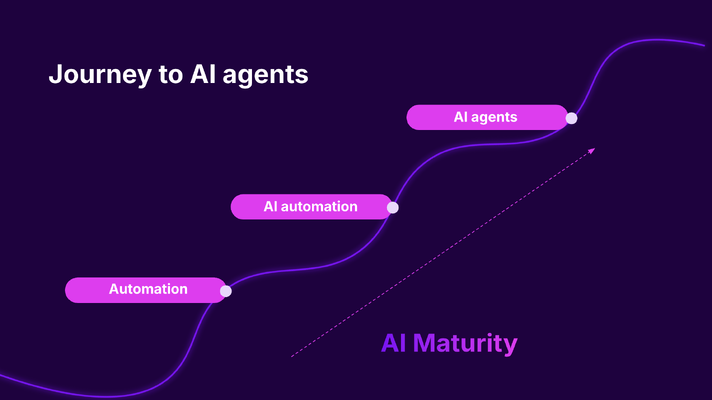
AI maturity ladder: automation, AI automation, and AI agents
For enterprise adoption, that ladder is still the right mental model. When you’re rolling AI into company processes, you want control: predictable triggers, clear inputs, governance, auditability. Automation gives you that. Agents come later, once the foundations are in place.
But individual builders don’t always start at the bottom. If you arrive without years of process-mapping behind you, agents often feel easier, not harder. You can start with a goal, give the LLM brain tools, and iterate toward an outcome without mastering workflow thinking upfront.
That’s why the ladder is only part of the story. It describes capability maturity at company level. It doesn’t always describe how people start. To see why, you need to look at what actually separates automation, AI automation, and agents. And it’s not just complexity. It’s the mental model each one requires.
If you want the full spectrum view (automation → AI automation → agentic automation), I shared the original framework in this Tekpon article.
Drawing the line between automation, AI automation, and agents
Classic automation and AI automation share the same DNA. Both are linear workflows. You define a trigger, you map out a sequence of steps, and the system executes them in order. If this, then that, then the next thing. It's a workflow logic brought to life: predictable, reliable, and mostly deterministic by design. A simple example? A lead intake flow. A new lead comes in, you enrich the company, assign an owner, update the CRM, and notify the right channel.
The difference between the classic automation and AI automation is one ingredient: an AI step inserted into that linear flow.
Instead of a rule-based action, you hand something off to a model – summarize this, rewrite that, extract meaning from this unstructured input. One non-deterministic moment inside an otherwise predictable pipeline. A typical pattern is support triage: the workflow still routes and logs everything, but the LLM classifies intent and drafts a first reply or summary for review. For example, you take a blog post, hand it to an LLM, and get back a LinkedIn draft. Same flow. One step becomes probabilistic.
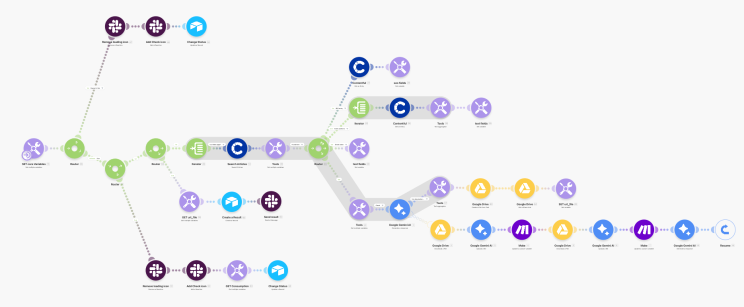
Example of a linear AI workflow
AI agents are something else entirely. You stop designing the sequence upfront. You stop asking "what happens first, what happens second?" and start asking "what does this problem actually need?" You put the LLM brain at the center, give it a set of tools (read this document, write to this platform, access this database), and let it figure out the order of operations itself. You describe the goal and the resources. The agent builds the path. That's not a tooling upgrade. That's a completely different mental model for how you approach a problem.Example of a non-linear agent
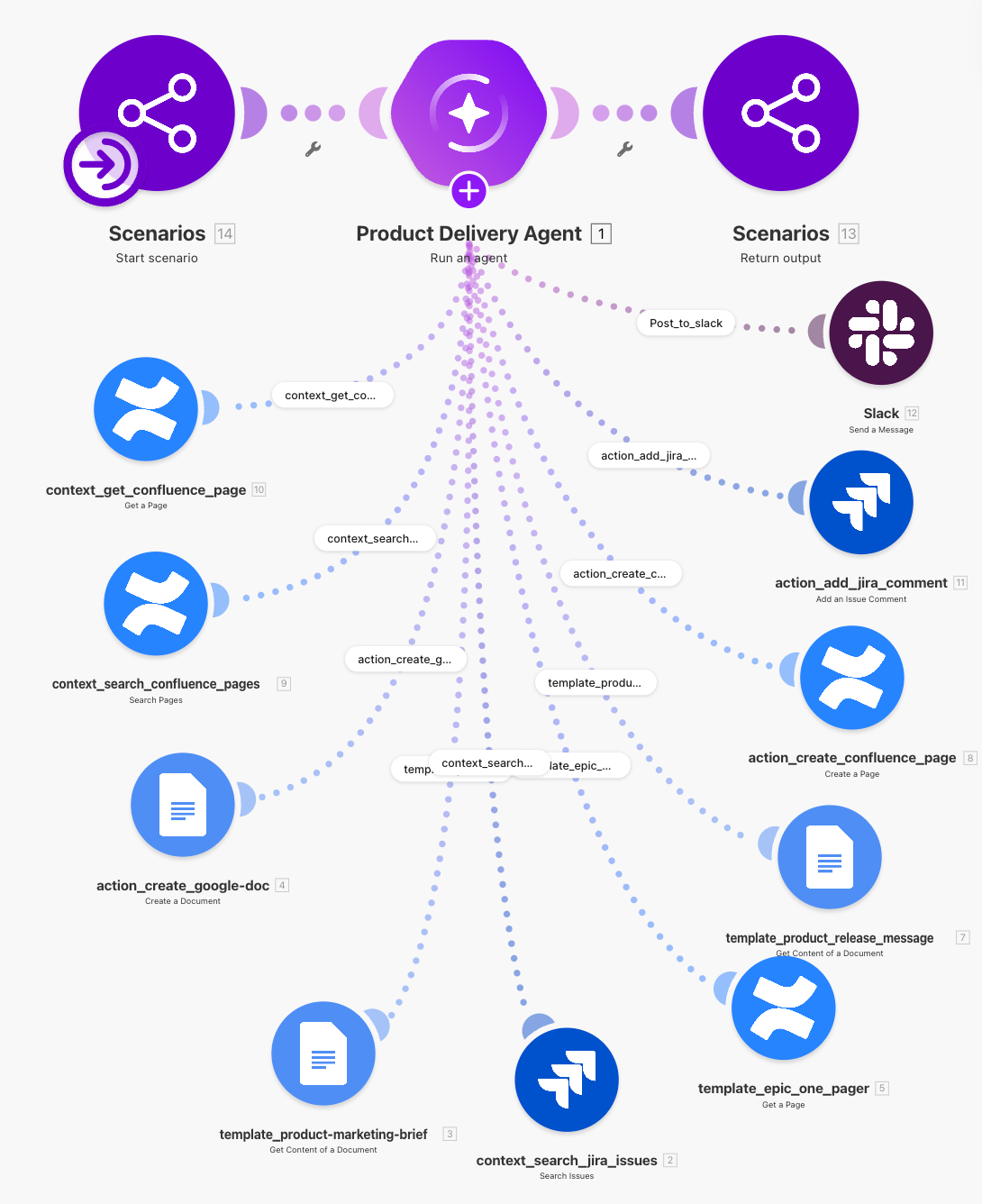
Example of an agent
Why process thinkers hit a wall
Here's where it gets interesting, and a little counterintuitive. What makes something feel hard or easy rarely comes down to "AI skill." It comes down to the mental model someone already has from how they've worked before.
People who come to automation with a background in operations, process design, or systems thinking are often excellent at building linear automations. They know how to decompose a workflow. They can map every step, anticipate every branch, and document every condition. That’s why AI automation often feels natural to them.
But when they try to build agents, the thing they're best at is exactly what they need to let go of. Agents don't want your workflow micromanagement. They want your problem statement and your toolbox. The instinct to pre-map every step, which is a genuine strength in automation, actively gets in the way when building agents.
It's a real change of building mindset, not just a tooling one. And for people who've spent years building automation, it can feel deeply uncomfortable to hand control over to the LLM brain and trust it to find the path.
Newcomers gravitate to agents, not workflows
Now flip the scenario. Someone comes to this space fresh. No process mapping background, no years of automation-building behind them. They have a problem they want to solve. They're not naturally thinking in step-by-step sequences – they're thinking in outcomes.
For them, classic automation is actually the harder starting point. You have to teach them a whole way of thinking before you can teach them the tool. You have to get them comfortable with flowcharts and triggers and linear logic, a skill set they've never needed to develop.
But agents? Agents speak their language. You have a problem. Here are the tools you'll need. Go.
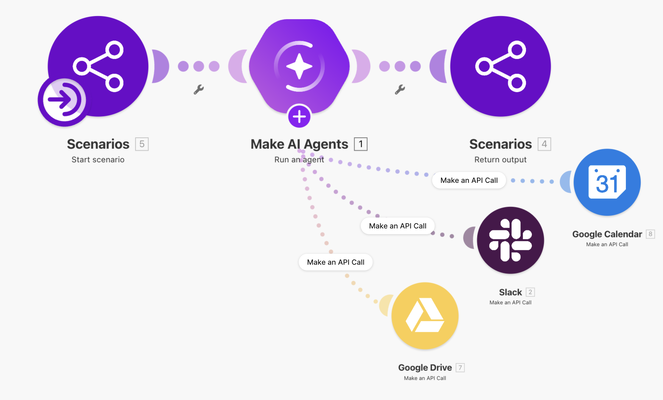
Personal agent with access to GDrive, Slack, and Calendar
This is where the trade-off shows up. Agents can feel like the “easier start” because they bypass process thinking at the beginning. But sooner or later, teams still run into the foundations: permissions, data hygiene, observability, guardrails. Agents don’t remove the need for structure. They change when you feel it.
The numbers support the pattern. At Make, AI automation still makes up the bigger share of what’s running (roughly 59% AI automation scenarios vs 41% AI agents). But when you look at new additions over time, agents are growing faster. And the split by builder profile is hard to ignore: experienced automators tend to stick with AI automation while newcomers go straight to agents.
They skip the intermediate step not because they're rushing, but because the intermediate step requires a skill they don't have yet – and agents don't ask for it. Not at the start.
Use this when you teach, onboard, or build a team
This isn't just an interesting pattern. It's practically useful. If you're onboarding someone into automation, the right starting point isn't the same for everyone. Someone with strong process instincts and a love of mapping workflows will thrive starting with automation and AI automation. That's their home turf. When they eventually move toward agents, just be honest with them: this requires a different posture. Less control, more trust. It's not harder technically. It's just different in a way that might feel uncomfortable at first.
But if someone comes in problem-first and outcome-oriented, not particularly interested in workflows, don't start by teaching them to think linearly. Let them build agents. Let them get comfortable with the tool through the mental model they already have. Then layer in sequencing, governance, and evals when the use case demands reliability.
Implementing AI in a team isn't just a technical decision. It's a change in how people think about work. Getting that wrong – putting the wrong entry point in front of the wrong person – slows adoption and creates unnecessary frustration. Getting it right speeds up confidence and real usage.
Don’t pick one path. Build the spectrum instead
Agents-first is a legitimate entry point for many builder profiles. But it’s not the whole answer. As workflows grow more complex and reliability becomes critical, the automation foundation matters. Classic step-by-step logic doesn’t become irrelevant just because agents exist. It’s what makes agentic systems deployable at scale.
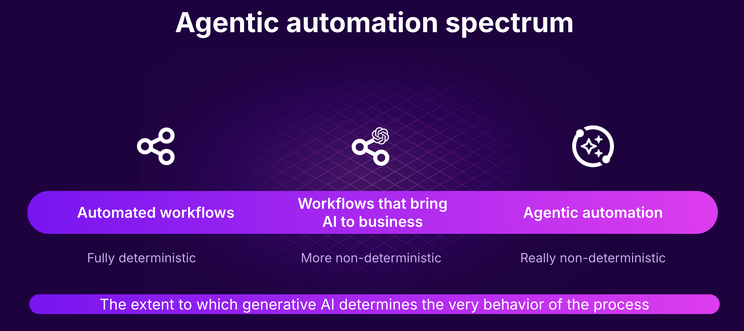
Agentic automation spectrum
The smartest teams aren’t choosing between automation and agents. They’re building a portfolio: knowing when to use a linear workflow, when to insert an AI step, and when to let an LLM brain route the problem end to end.
Sequence when you must. Solve when you can.